Blog

Can a Teenage Child Choose Which Parent to Live With in Florida?

When parents go through a divorce or separation, few topics create more emotional stress than deciding where a child will live. One of the most common questions family law attorneys receive, especially when the child is a teenager, is:

“Can my child decide which parent they want to live with?”

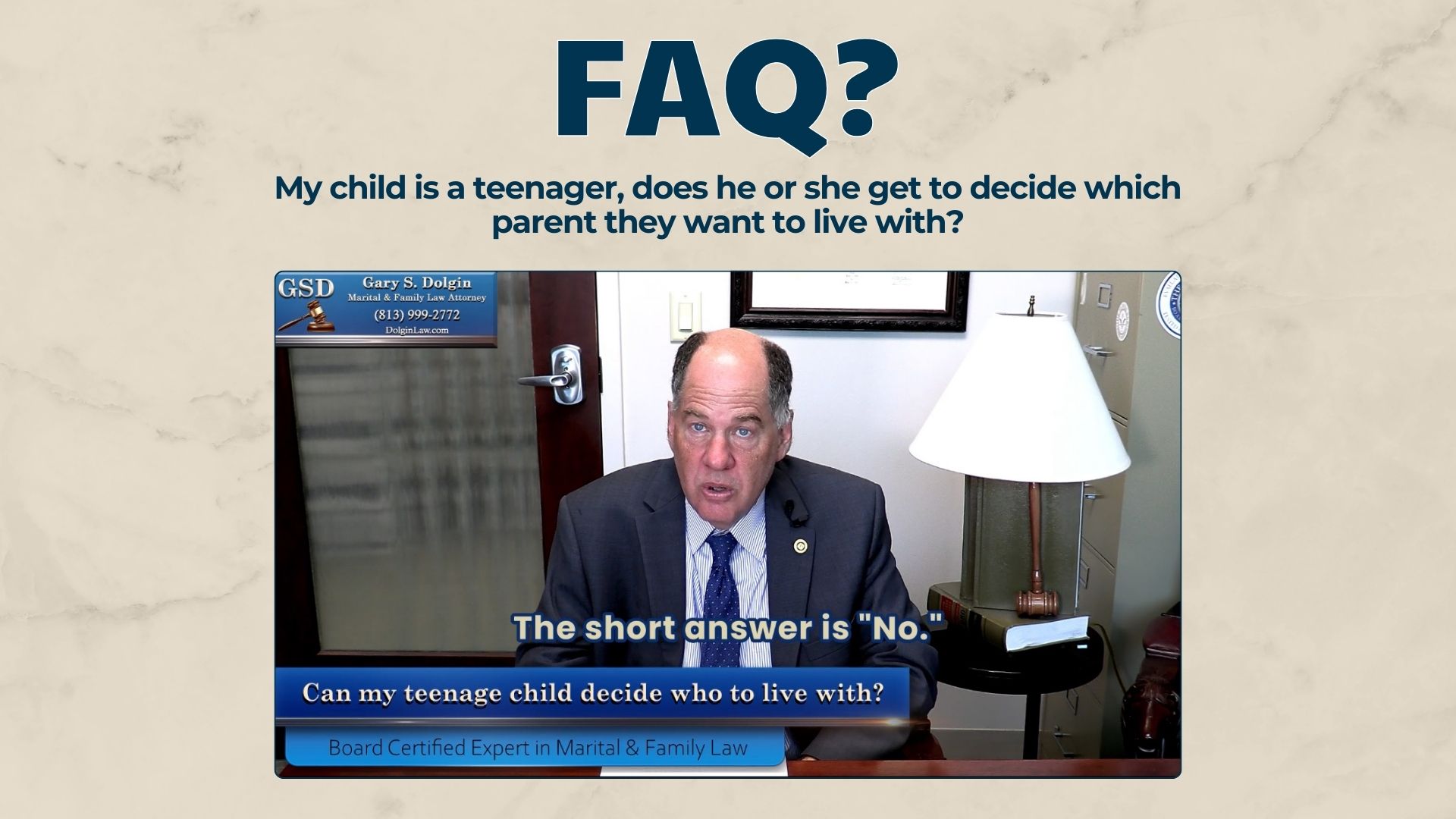
According to Gary S. Dolgin, Board Certified Expert in Marital and Family Law with over 35 years of experience, the short answer is no. However, a child’s preference can play a role in a judge’s decision, depending on their age, maturity, and specific circumstances.

Understanding how Florida courts evaluate this issue can help parents approach custody, or “time-sharing,” as Florida law calls it, with realistic expectations and confidence.

Understanding Florida’s Time-Sharing Law

In Florida, the term “child custody” has been replaced with time-sharing and parental responsibility under Florida Statute §61.13. This statute outlines how parenting plans are created, how time with the child is divided, and and whether both parents will jointly make decisions about education, health care, and other major decisions regarding the child, or if one parent will be granted ultimate decision-making authority over the child’s life.

The goal is always to serve the best interests of the child, not necessarily the preferences of the parents, or even the child alone.

The “Best Interests of the Child” Standard

When determining time-sharing and parental responsibility, Florida courts are guided by what’s known as the “best interests of the child” standard.

Florida Statute §61.13(3) lists 20 specific factors that judges must consider before making any custody or time-sharing determination. These factors include everything from the parents’ ability to meet the child’s needs, to each parent’s moral fitness, mental health, and the stability of the home environment.

Here are some of the most important factors that frequently come into play:

– The ability of each parent to encourage a close and continuing parent-child relationship.

– The anticipated division of parental responsibilities after the litigation.

– The moral fitness, mental health, and physical health of each parent.

– The home, school, and community record of the child.

– The reasonable preference of the child, if the court deems the child to be of sufficient intelligence, understanding, and experience to express a preference.

– Evidence of domestic violence, sexual violence, abuse, or neglect.

– The ability of each parent to provide a consistent routine, including discipline, meals, and homework.

– The length of time the child has lived in a stable environment and the desirability of maintaining continuity.

– The capacity of each parent to communicate with the other parent and participate in major decisions affecting the child’s welfare.

This list helps make the judge’s decision a holistic assessment of the child’s entire life situation, rather than just one or two factors.

Where a Child’s Preference Fits In

The factor regarding a child’s reasonable preference is often misunderstood.

Many parents assume that once a child reaches a certain age, such as 13, 15, or 17 they can simply “choose” where to live. Florida law does not establish any specific age at which a child can make that decision.

Instead, the judge has discretion to decide whether a child is mature enough to express a meaningful preference and how much “weight” to give that opinion.

“A child’s preference can be taken into account if they are of sufficient maturity,” explains Attorney Gary Dolgin. “However, we never want to put a child in the position of making that decision. A judge can give whatever weight they feel is appropriate to the child’s preference, taking that into account with the other 19 factors.”

Can a Teenager Decide Custody in Florida

Why Judges Avoid Letting Children Decide

While a child’s opinion matters, judges and family law professionals are cautious about giving children too much responsibility in these decisions.

As Mr. Dolgin notes, no child should ever be put in the position of choosing between parents. Doing so can create long-term emotional stress and guilt, even if the child’s preference seems clear.

Judges also understand that children can be easily influenced by short-term factors, such as which parent is more lenient, offers more freedom, or buys them more gifts. For that reason, the court looks beyond surface-level preferences and focuses on what environment will best support the child’s growth and stability.

How a Judge Evaluates a Teenager’s Preference

If a judge decides to consider the child’s wishes, the process is handled with sensitivity and discretion. Typically, the child will not testify in open court. Instead, the judge may:

1. Speak privately with the child in chambers (without the parents present) to understand their feelings, however, many judges are reluctant to interview a child and prefer to rely on the recommendation of a psychologist or guardian ad litem.

2. Rely on a guardian ad litem — a neutral advocate appointed to represent the child’s best interests.

3. Consider psychological evaluations or school counselor input to gauge maturity and emotional stability.

The judge will then weigh the child’s opinion alongside all other statutory factors before determining a parenting plan.

In some cases, a mature teenager’s consistent, well-reasoned preference may carry significant weight. In others, the court may give it little consideration if it appears the child’s choice is influenced by manipulation or temporary emotions.

Each case is unique — which is why having an experienced, Board Certified attorney is crucial to present these factors effectively.

The Role of a Board Certified Family Law Attorney

When navigating issues of custody, time-sharing, and child preference, it’s vital to have legal guidance from someone who is not only experienced but also Board Certified in Marital and Family Law.

Gary S. Dolgin is one of only 274 attorneys in the entire State of Florida with this distinction. Board Certification is the highest level of recognition given by The Florida Bar, reserved for attorneys who have demonstrated exceptional competence, ethics, and professionalism in their field.

With over three decades of experience in family law, Mr. Dolgin has helped countless families in the Tampa Bay area navigate complex time-sharing and custody matters with compassion and expertise.

The Importance of Proper Legal Guidance

Because time-sharing decisions are highly fact-specific, it’s risky for parents to rely on hearsay, internet information, or assumptions about what a judge “usually does.”

An attorney like Gary Dolgin can:

– Help you understand how the 20 statutory factors apply to your unique case.

– Prepare evidence showing your ability to meet your child’s best interests.

– Ensure that your child’s voice is heard appropriately — without causing emotional harm.

– Negotiate fair parenting plans that reduce conflict and protect your child’s emotional well-being.

The goal is always to create a stable, loving environment where the child can thrive, while respecting both parents’ roles in the child’s life.

Protecting Children from Conflict

Family law judges, guardians, and attorneys all share one guiding principle: children should be shielded from adult conflict.

Encouraging a child to “choose sides” can create deep emotional scars and complicate the healing process after divorce. Instead, parents are encouraged to:

– Keep conversations about custody between adults.

– Reassure children that both parents love them.

– Avoid making negative comments about the other parent in the child’s presence.

– Focus on consistency, love, and communication.

As Mr. Dolgin emphasizes, “We never want to put a child in the position of making that decision.”

A judge’s role — and your attorney’s — is to ensure the child’s well-being remains the top priority.

What Happens If Parents Can’t Agree on Time-Sharing

If parents cannot agree on a parenting plan, the court will create one based on the evidence presented. The judge may order mediation, psychological evaluations, or the appointment of a guardian ad litem to assess family dynamics.

The court will then issue a Parenting Plan, which defines:

1. The time each parent spends with the child (time-sharing schedule).

2. Decision-making authority for major issues like education, health, and extracurriculars.

3. Communication expectations between parents.

This Parenting Plan becomes legally binding — and modifying it later requires showing a substantial change in circumstances and that the change is in the child’s best interests.

Frequently Asked Questions

Question: Can a teenager choose which parent to live with in Florida?
Answer: No. A teen’s preference may be considered by the court but it is only one of the best-interest factors under Florida Statute 61.13. The judge decides based on all relevant factors, including the child’s maturity and each parent’s ability to meet the child’s needs.

Question: At what age will a Florida court consider a child’s preference?
Answer: There is no specific age. Courts look at whether the child is sufficiently mature to express a well-reasoned preference. Older teens often receive more weight, but maturity—not age alone—controls.

Question: How does a judge hear a child’s preference?
Answer: Judges may rely on testimony from parenting evaluators or, in some cases, speak with the child in camera (privately in chambers) to avoid placing the child in the middle of the dispute.

Question: What other factors affect time-sharing decisions?
Answer: Courts consider many factors, including each parent’s involvement, stability, moral fitness, mental and physical health, co-parenting, the child’s school and community history, and any evidence of domestic violence, among others listed in Florida Statute 61.13.

Question: Should I ask my child to choose a parent?
Answer: Generally no. Courts discourage placing children in the position of choosing. Instead, work with an experienced family-law attorney to present the child’s needs appropriately and build a parenting plan that supports the child’s best interests.

When to Seek Legal Help

If you’re facing a custody or time-sharing dispute in Tampa, it’s important to seek legal advice early. Even if you and your co-parent have an amicable relationship, the process involves strict statutory requirements and detailed documentation.

A consultation with an experienced attorney like Gary S. Dolgin can help you understand your rights under Florida law, avoid common mistakes that could hurt your case, and help you develop a strategy that prioritizes your child’s needs while protecting your parental rights.

About The Law Offices of Gary S. Dolgin

Located in Tampa, Florida, The Law Offices of Gary S. Dolgin focuses exclusively on Marital and Family Law, including:

– Divorce and equitable distribution

– Child custody and time-sharing disputes

– Alimony and support modifications

– Paternity and parental responsibility matters

With a reputation built on trust, integrity, and compassion, Gary Dolgin and his team treat every client like family — guiding them through some of life’s most difficult transitions with professionalism and care.

If you have questions about time-sharing, parental responsibility, or child custody laws in Florida, we’re here to help.

To schedule a consultation with Gary S. Dolgin, Attorney At Law, call (813) 999-2772 and it will be our pleasure to help you.

Why Do I Need a Lawyer for My Uncontested Divorce?

Even in an uncontested divorce, where both parties agree on key issues, having a lawyer can make the process smoother and more secure. Here’s why hiring an attorney is essential:

Ensuring Proper Documentation

A divorce involves numerous legal documents that must be completed accurately and submitted on time. A lawyer ensures all forms are correctly prepared, minimizing the risk of delays or errors that could complicate your case.

Understanding Legal Rights

Even when both parties agree, it’s vital to understand your legal rights regarding property division, child custody, and support arrangements. A lawyer helps ensure your interests are protected and no important details are overlooked.

Avoiding Future Disputes

An uncontested divorce may seem straightforward, but poorly drafted agreements can lead to misunderstandings or disputes later. A skilled attorney ensures the settlement is clear, comprehensive, and enforceable, reducing the chance of future conflicts.

Navigating State-Specific Laws

Divorce laws vary by state, and an experienced lawyer understands the specific requirements and procedures in your jurisdiction. This knowledge is crucial for a seamless process.

Saving Time and Reducing Stress

Filing for divorce involves navigating the legal system, which can be overwhelming. A lawyer streamlines the process, allowing you to focus on moving forward with your life.

Contested Divorce FAQs

Question: What is an uncontested divorce in Florida?
Answer: An uncontested divorce means both spouses agree on all major issues such as property division, alimony, and parenting arrangements. However, the process still requires careful legal filing and court approval to make the agreement final.

Question: How long does an uncontested divorce take in Florida?
Answer: In most cases, an uncontested divorce can be finalized within 30 to 60 days after filing, depending on the county’s court schedule and how quickly all documents are submitted and approved.

Question: Can an uncontested divorce become contested?
Answer: Yes. If either spouse changes their mind about any term — such as child custody, property division, or alimony — the case can become contested. Having an attorney helps prevent disputes by drafting a clear, legally enforceable agreement.

Question: How much does an uncontested divorce cost in Florida?
Answer: Uncontested divorces typically cost significantly less than contested ones. Fees vary depending on whether you hire an attorney, but having a lawyer can save money in the long run by ensuring accuracy and preventing costly future disputes.

Peace of Mind

Even in amicable situations, having a lawyer gives you confidence that everything has been handled correctly and fairly. This peace of mind is invaluable during a challenging time.

Hiring an experienced attorney like Gary Dolgin, who is Board Certified in Marital and Family Law, ensures your uncontested divorce is managed efficiently, protecting your rights and providing clarity for the future.

With over 35 years in practice, Board Certified Expert in Marital and Family Law, Gary Dolgin is an experienced and knowledgeable divorce attorney in Tampa who can represent your best interests.

To schedule a consultation with Gary S. Dolgin, Attorney At Law, call (813) 999-2772 and it will be our pleasure to help you.

To see what past clients have to say about retaining Gary Dolgin to represent them during their divorce, and to learn more about divorce, visit:
Best Divorce Attorney in Tampa – Gary S. Dolgin

Google Business Page:
Divorce Attorney Near Me – Gary Dolgin
625 E. Twiggs St., Suite 101i
Tampa, Florida 33602

Facebook Page: Tampa Divorce Attorney – Gary Dolgin

How Do I Know If a Divorce Lawyer Is Good?

Choosing the right divorce lawyer can significantly impact the outcome of your case. But with so many attorneys out there, how do you know if a divorce lawyer is good? Here are some key factors to consider when making this important decision.

Experience in Marital and Family Law

A good divorce lawyer should have extensive experience in marital and family law. This specialization ensures they are well-versed in the nuances of divorce proceedings, child custody arrangements, and asset division. An attorney like Gary Dolgin, who has 34 years of experience in this field, brings a wealth of knowledge to the table.

Board Certification

Board certification is a mark of excellence and a testament to an attorney’s expertise. Board Certified Marital and Family Lawyers have demonstrated exceptional expertise, passing a rigorous exam, peer review, and meeting strict experience requirements, including handling complex family law cases. They must complete extensive continuing education and are re-certified every five years, ensuring they stay at the forefront of their field. Choosing a Board Certified lawyer like Gary Dolgin means trusting an expert recognized for their competence, ethics, and dedication to guiding clients through divorce and family law matters.

Strong Communication Skills

Effective communication is crucial in legal matters. A good divorce lawyer should be able to explain complex legal terms in plain language, keep you informed about your case, and be responsive to your concerns. This ensures you are always in the loop and can make informed decisions.

Positive Client Testimonials

Feedback from previous clients can provide valuable insights into a lawyer’s capabilities. Look for testimonials that highlight the attorney’s professionalism, compassion, and success in handling cases similar to yours.

Personalized Attention

Every divorce case is unique, and a good lawyer should offer personalized attention to address your specific needs. They should take the time to understand your situation and develop a strategy that aligns with your goals.

Reputation in the Legal Community

A respected lawyer often has a strong reputation among peers and within the legal community. This can be an indicator of their professionalism and the quality of their work.

How Do I Know If a Divorce Lawyer Is Good?

Determining if a divorce lawyer is good involves considering their experience, credentials, communication skills, and reputation. Attorneys like Gary Dolgin, with decades of experience and board certification in marital and family law, exemplify the qualities you should look for. By choosing a lawyer who meets these criteria, you can navigate your divorce proceedings with confidence.


With over 34 years in practice, Board Certified Expert in Marital and Family Law, Gary Dolgin is an experienced and knowledgeable divorce attorney in Tampa who can represent your best interests.

To schedule a consultation with Gary S. Dolgin, Attorney At Law, call (813) 999-2772 and it will be our pleasure to help you.

To see what past clients have to say about retaining Gary Dolgin to represent them during their divorce, and to learn more about divorce, visit:
Best Divorce Attorney in Tampa – Gary S. Dolgin

Google Business Page:
Divorce Attorney Near Me – Gary Dolgin
625 E. Twiggs St., Suite 101i
Tampa, Florida 33602

Facebook Page: Tampa Divorce Attorney – Gary Dolgin

Do Family Law Lawyers Deal with Divorce Cases?

Absolutely, family law lawyers, including Tampa’s own Gary Dolgin, frequently handle divorce cases as a central part of their practice. Divorce is a complex legal area within family law, requiring skilled navigation of sensitive issues like child custody, child support, alimony, and property division. These cases often demand an attorney who can provide both compassionate guidance and knowledgeable advocacy to help clients through this challenging life transition.


The Role of Family Law Lawyers in Divorce Cases

Family law lawyers play a pivotal role in divorce cases. They not only manage the legal complexities but also ensure their clients’ rights and interests are protected throughout the process. In Florida, where divorce laws have unique regulations, it is critical to work with a family law attorney familiar with state-specific guidelines. This expertise is vital for securing fair agreements on financial matters, child custody arrangements, and the equitable division of marital assets.

Divorce cases often involve emotionally charged issues, making the attorney’s ability to provide a steady, informed, and compassionate presence invaluable. A lawyer like Gary Dolgin brings years of experience in Florida family law, helping clients feel supported while advocating for outcomes that respect their unique circumstances.


Why Consult an Experienced Family Law Lawyer?

For those in Tampa facing the challenges of divorce, consulting an experienced family law attorney can be invaluable. Lawyers like Gary Dolgin provide:

•        Knowledge of Florida Family Law: Expertise in the most recent divorce-related statutes ensures clients achieve legally sound outcomes.

•        Personalized Advocacy: Every divorce case is unique, and an experienced lawyer tailors their approach to meet the client’s individual needs.

•        Emotional and Legal Support: Divorce is not just a legal matter but a deeply personal one, and having a supportive attorney by your side makes a significant difference.


With over 34 years in practice, Board Certified Expert in Marital and Family Law, Gary Dolgin is an experienced and knowledgeable divorce attorney in Tampa who can represent your best interests.

To schedule a consultation with Gary S. Dolgin, Attorney At Law, call (813) 999-2772 and it will be our pleasure to help you.

To see what past clients have to say about retaining Gary Dolgin to represent them during their divorce, and to learn more about divorce, visit:
Best Divorce Attorney in Tampa – Gary S. Dolgin

Google Business Page:
Divorce Attorney Near Me – Gary Dolgin
625 E. Twiggs St., Suite 101i
Tampa, Florida 33602

Facebook Page: Tampa Divorce Attorney – Gary Dolgin

Best Tampa Divorce Lawyer Helps You Understand Equitable Distribution of Assets and Liabilities in Divorce

Divorce is a big change that’s often tough emotionally. One major part of divorce is sharing what the couple owns and owes fairly.

This legal process looks at everything the couple has gathered during marriage and divides it between them. Let’s take a closer look at how this works and how an experienced Tampa divorce lawyer can help protect your best interests.

Understanding Assets

First, it’s important to split things into two groups: “marital” and “nonmarital.”

Marital assets encompass properties acquired during the marriage, ranging from tangible assets like homes and vehicles to intangible assets such as bank accounts, investments, and retirement savings.

Conversely, nonmarital assets include properties acquired before the marriage, through inheritance, or designated as non-marital through a prenuptial agreement.

Figuring Out Valuation

Once things are sorted, it’s time to see how much everything is worth.

This can be tricky and might require appraisals, financial experts, expert testimony, or other methods to ascertain the fair market value of each marital asset.

Accurate valuation is paramount as it lays the foundation for an equitable distribution that reflects the true worth of each asset.

Exploring Distribution Factors

With asset valuation completed, the court considers a variety of factors to decide how to distribute them equitably.

The court must begin with the premise that the distribution should be equal unless there is a justification for an unequal distribution based on all relevant factors, which include the following:

(a) The contribution to the marriage by each spouse, including contributions to the care and education of the children and services as homemaker.
(b) The economic circumstances of the parties.
(c) The duration of the marriage.
(d) Any interruption of personal careers or educational opportunities of either party.
(e) The contribution of one spouse to the personal career or educational opportunity of the other spouse.
(f) The desirability of retaining any asset, including an interest in a business, corporation, or professional practice, intact and free from any claim or interference by the other party.
(g) The contribution of each spouse to the acquisition, enhancement, and production of income or the improvement of, or the incurring of liabilities to, both the marital assets and the nonmarital assets of the parties.
(h) The desirability of retaining the marital home as a residence for any dependent child of the marriage, or any other party, when it would be equitable to do so, it is in the best interest of the child or that party, and it is financially feasible for the parties to maintain the residence until the child is emancipated or until exclusive possession is otherwise terminated by a court of competent jurisdiction. In making this determination, the court shall first determine if it would be in the best interest of the dependent child to remain in the marital home; and, if not, whether other equities would be served by giving any other party exclusive use and possession of the marital home.
(i) The intentional dissipation, waste, depletion, or destruction of marital assets after the filing of the petition or within 2 years prior to the filing of the petition.
(j) Any other factors necessary to do equity and justice between the parties.

Court Decisions

In instances where spouses cannot agree on asset division through negotiation or mediation, the court intervenes to render a final decision.

The court’s decision is guided by a commitment to fairness and equity, considering the specific circumstances of the case.

To conclude, equitable distribution of marital assets and liabilities is a multifaceted process that requires attention to detail and a comprehensive understanding of various factors.

It may become overwhelming, but seeking guidance from experienced legal counsel can provide clarity and direction. The goal is to ensure a fair and just division of assets and liabilities so both parties can move on with confidence and peace of mind.

If you’re facing divorce, and need assistance determining equitable distribution of your marital assets and liabilities, don’t hesitate to seek the guidance of the best divorce lawyer in Tampa who can protect your financial interests and advocate for a fair resolution.

Paternity Rights Tampa – The law as it pertains to a couple who have a child out of wedlock.

When a child is born out of wedlock, the legal dynamics of parental rights and responsibilities can be complex. However, the law provides clear guidelines to ensure that both parents have a defined role in the child’s life. (See Florida Statutes)

This is crucial for the child’s overall development and well-being, as it ensures that both parents are involved in their upbringing.

In cases where paternity has been established under Florida Statutes s. 742.011 or s. 742.10, both the mother and the father of the child are recognized as the natural guardians. This designation as natural guardians means that both parents are legally acknowledged as having equal rights and responsibilities concerning the upbringing, care, and welfare of the child.

All decisions and arrangements made under the natural guardianship are ultimately guided by what is in the best interest of the child. Courts and legal frameworks prioritize the child’s welfare, ensuring that both parents fulfill their roles effectively. This approach helps to create a stable and supportive environment for the child, promoting their physical, emotional, and psychological development while ensuring that they receive the care and attention they need from both parents.

Here at The Law Offices of Gary S. Dolgin, we have been helping mothers and fathers with child custody issues such as parenting plans for over 33 years in the Tampa area.

We have also been committed to protecting children’s best interests while helping to advocate for their parent’s rights.

If you have any questions about parenting plans or any other child custody issues, give us a call at (813) 999-2772, and it will be our pleasure to help you.

Learn more about child custody and paternity rights Tampa, by visiting:
Best Child Custody Lawyer in Tampa

In this New York Times article “You Don’t Need a French Vineyard to Have a Prolonged Divorce Proceeding,” divorce lawyers discuss the importance of guiding divorcing couples towards faster resolutions rather than letting disputes drag on.

You can read the full article at: Avoid A Prolonged Divorce

💔 With all the issues that need to be agreed upon during a divorce, emotions can run high, leading to a long, drawn-out process! Even without high-value assets, divorces can drag on due to child custody battles and asset disputes. 🤯

The length of time it takes to settle a divorce is largely determined by the divorcing parties, and how willing they are to settle.

Emotions can run high, and couples can find themselves arguing for months over trivial items.

Mediation can be a big help in speeding up the process, but it ultimately comes down to whether or not the parties are willing to agree. 🕊️

As divorce lawyers, it is important to remind clients that their emotional well-being is just as important as financial settlements. 💼❤️

When divorce attorneys use collaborative approaches between one another, it can help make the divorce process less stressful and more efficient, avoiding unnecessary court battles for their clients. ⚖️✨

With over 33 years in practice, Board Certified Expert in Marital and Family Law, Gary Dolgin is an experienced and knowledgeable divorce attorney in Tampa who can represent your best interests.

To schedule a consultation with Gary S. Dolgin, Attorney At Law, call (813) 999-2772 and it will be our pleasure to help you.

To see what past clients have to say about retaining Gary Dolgin to represent them during their divorce, and to learn more about divorce, visit:
Tampa Divorce Lawyer – Gary S. Dolgin

Google Business Page:
Divorce Attorney Tampa
625 E. Twiggs St., Suite 101i
Tampa, Florida 33602

Facebook Page:
Best Divorce Attorney In Tampa

Mediation can be an effective, convenient, and cost-effective way to resolve your divorce issues or family law disputes in a more peaceful manner than going through the courts.

As a Florida Supreme Court Certified Family Law Mediator, Gary Dolgin will use his 33 years of experience and skills in dispute resolution to help you come to a fair agreement regarding your family law issues during mediation.

Gary can assist you in making educated compromises by helping you understand how the courts may decide on specific issues.

This will help you have more control over the outcome of your issues through peaceful negotiation, instead of leaving the final decisions to the courts.

If you are having a dispute involving divorce issues such as child custody, visitation, child support, alimony, equitable distribution, or any other family law issue such as domestic violence or marital misconduct Gary Dolgin can help you resolve your issues efficiently during mediation.

To schedule a mediation session with Gary S. Dolgin, Attorney At Law, call (813) 999-2772 and it will be our pleasure to help you.

To see what past clients have to say about working with Gary Dolgin, and to learn more about mediation, visit:
Divorce Mediator Tampa – Gary S. Dolgin

Google Business Page: Family Mediator Tampa

Facebook Page: Divorce Mediation Tampa

What Are The Types of Alimony in Florida – Understanding Alimony in Florida Dissolution of Marriage Proceedings

In a proceeding for dissolution of marriage (divorce) in Florida, the court has the authority to grant alimony to either spouse. Alimony is financial support provided by one spouse to the other and can take various forms depending on the specific circumstances of the case. The primary goal is to ensure fairness and economic balance post-divorce. Here’s a detailed look at the types of alimony, the payment structures, and the factors influencing the court’s decisions.

Types of Alimony

Temporary Alimony

Temporary alimony is awarded to support a spouse during the divorce proceedings. For example, if one spouse has been a homemaker and lacks immediate income, the court may grant temporary alimony to cover living expenses until the divorce is finalized.

Bridge-the-Gap Alimony

Bridge-the-gap alimony helps a spouse transition from married life to single life, covering short-term needs. This type of alimony is typically limited to a maximum of two years. For instance, it might cover the cost of moving to a new residence or other short-term expenses.

Rehabilitative Alimony

Rehabilitative alimony is designed to assist a spouse in becoming self-sufficient through education, training, or work experience. The receiving spouse must present a specific plan outlining the steps to achieve financial independence. For example, if a spouse needs to complete a degree or vocational training to re-enter the workforce, rehabilitative alimony would cover the associated costs.

Durational Alimony

Durational alimony may be awarded to provide a party with economic assistance for a set period of time. An award of durational alimony terminates upon the death of either party or upon the remarriage of the obligee. Durational alimony may not be awarded following a marriage lasting less than 3 years. An award of durational alimony may not exceed 50 percent of the length of a short-term marriage, 60 percent of the length of a moderate-term marriage, or 75 percent of the length of a long-term marriage. Under exceptional circumstances, the court may extend the term of durational alimony.

Payment Structures

Periodic Payments

The court may order alimony to be paid periodically, typically monthly. For example, the paying spouse might be required to pay $1,000 per month for a specified duration. This method ensures a steady stream of income for the receiving spouse.

Lump Sum Payments

Alternatively, the court may award alimony as a lump sum payment. This could occur when dividing substantial marital assets, where one spouse might receive a one-time payment instead of ongoing support. For instance, instead of monthly payments, the paying spouse might provide a single payment of $50,000 to cover alimony obligations.

Consideration of Adultery and Economic Impact

Adultery and Alimony Awards

In determining the amount and type of alimony, the court may consider the adultery of either spouse and any resulting economic impact. For example, if one spouse’s adultery led to significant financial expenditures, such as lavish gifts for someone or using marital funds for extramarital activities, the court may adjust the alimony award to account for this economic impact.

Example Scenario

Suppose during the marriage, the husband engaged in an extramarital affair and spent considerable marital assets on the affair, including expensive trips and gifts. The wife, seeking a divorce, can present this evidence in court. The court may then consider these expenditures when determining the alimony award, potentially increasing the alimony to compensate for the financial misconduct.

Factors Influencing Alimony Decisions

The court considers various factors to determine the appropriateness and amount of alimony, including:
– The standard of living established during the marriage
– The duration of the marriage
– The age and physical and emotional condition of each spouse
– The financial resources and income potential of each spouse
– The contributions of each spouse to the marriage, including homemaking and childcare
– The responsibilities each spouse will have with regard to any minor children they have in common

Example Considerations

-Standard of Living: If the couple enjoyed a high standard of living during their marriage, the court may aim to allow both parties to maintain a similar standard post-divorce, to the extent possible.
– Duration of Marriage: In a marriage of 15 years, the court might lean towards awarding durational alimony to provide financial support to the lower-earning spouse for a period equivalent to the marriage duration.
– Health and Age: If one spouse is significantly older or has health issues that limit their earning potential, the court may award more substantial or longer-term alimony.

Alimony is a critical aspect of divorce proceedings in Florida, designed to ensure fairness and support for both parties as they transition to independent lives. The court’s decision on the type, amount, and duration of alimony considers various factors, including the contributions and needs of each spouse, as well as any misconduct like adultery that has had an economic impact. Understanding these aspects can help divorcing spouses prepare for the financial implications of dissolution and seek fair support arrangements.

If you or someone you know is facing divorce, and need the guidance of an experienced divorce attorney who can assist you in understanding your alimony rights and obligations, don’t hesitate to look for the best alimony attorney in Tampa who can help you navigate the Florida alimony laws during your divorce.

What constitutes marital assets in Florida?

Best divorce attorney in Tampa, Gary Dolgin shares some important information regarding this.

In Florida, the division of assets and liabilities during a divorce follows the principle of equitable distribution. This means that all marital property and debts are divided fairly between the spouses.

The distribution of all marital assets and marital liabilities, whether equal or unequal, shall include specific written findings of fact as to:

(b) Identification of marital assets, including the individual valuation of significant assets, and designation of which spouse shall be entitled to each asset.

This process begins with a thorough inventory of all assets acquired during the marriage, regardless of whose name the asset is in.

Marital assets can include real estate, bank accounts, retirement accounts, investments, vehicles, businesses, and personal property such as jewelry and furniture.

Both parties are required to disclose all relevant financial information and documents to ensure that all assets are accounted for. This might involve gathering financial statements, property deeds, vehicle titles, business records, and appraisals.

If you’re going through a divorce, it’s crucial to understand your rights and the factors that influence asset and liability division. Seeking guidance from a knowledgeable attorney can ensure a fair outcome.

If you are considering divorce and have questions about equitable distribution, we can help you here at The Law Offices of Gary S. Dolgin.

With over 33 years in practice, Board Certified Expert in Marital and Family Law, Gary Dolgin is an experienced and knowledgeable divorce attorney in Tampa who can represent your best interests.

To schedule a consultation with Gary S. Dolgin, Attorney At Law, call (813) 999-2772 and it will be our pleasure to help you.

To see what past clients have to say about retaining Gary Dolgin to represent them during their divorce, and to learn more about divorce, visit:
Best Divorce Attorney in Tampa – Gary S. Dolgin

Google Business Page:
Divorce Attorney Near Me – Gary Dolgin
625 E. Twiggs St., Suite 101i
Tampa, Florida 33602

Facebook Page: Tampa Divorce Attorney – Gary Dolgin