
How Much Alimony Will I Receive if I’m Divorcing in Tampa, Florida?
Alimony is one of the most misunderstood and emotionally charged issues in Florida family law. Whether you expect to receive alimony or believe you may be required to pay it, the outcome can have long-term financial consequences.
In Tampa and Hillsborough County, alimony decisions are made under Florida Statute 61.08, and they are highly fact-specific. There is no one-size-fits-all formula.
In this article, Gary Dolgin, a Board Certified Expert in Marital and Family Law with more than 35 years of experience, explains how alimony is determined in Florida and how courts in Hillsborough County analyze alimony cases.
What is Alimony Under Florida Law?
Alimony (also known as spousal support) is a court-ordered payment from one spouse to the other following a divorce. The purpose of alimony is to help one spouse meet reasonable financial needs when there is a disparity in income or earning capacity.
Florida law does not guarantee alimony in every divorce. Instead, courts evaluate whether alimony is appropriate based on statutory factors and the financial realities of both spouses.
The Two Important Questions in Every Tampa Alimony Case
Before any type or amount of alimony can be awarded, a judge in Hillsborough County must answer two essential questions:
1. Does One Spouse Have a Genuine Financial Need?
The court examines whether one spouse lacks the financial resources to meet reasonable monthly living expenses.
This analysis often includes:
- Housing and utility costs
- Food, transportation, and insurance
- Medical and healthcare expenses
- Other necessary monthly obligations
2. Does the Other Spouse Have the Ability to Pay?
Even if financial need exists, alimony cannot be awarded unless the other spouse has the financial ability to pay.
Judges consider:
- Income and earning capacity
- Assets and liabilities
- Existing financial responsibilities
If either need or ability to pay is missing, alimony may be denied.
Factors Florida Courts Use to Determine Alimony
After establishing that one spouse has a financial need and the other has the ability to pay, Florida courts evaluate a comprehensive list of statutory factors under Florida Statute 61.08 to determine whether alimony is appropriate, as well as the type, amount, and duration of alimony.
In Tampa and Hillsborough County, judges carefully examine these factors to reach a fair and equitable outcome:
- Length of the marriage – Florida law categorizes marriages as short-term, moderate-term, or long-term. The length of the marriage plays a significant role in determining whether alimony is awarded and how long it may last.
- Standard of living established during the marriage -Courts attempt to assess the lifestyle enjoyed during the marriage, including housing, travel, and overall spending patterns, to determine reasonable post-divorce needs.
- Age and physical and emotional condition of each spouse – Health conditions, disabilities, or age-related limitations may affect a spouse’s ability to work or become self-supporting.
- Financial resources of each spouse – This includes income, assets, liabilities, and non-marital property available to meet financial needs.
- Earning capacities, education, and employability – Judges evaluate whether a spouse can realistically become self-supporting and what steps, if any, are required to do so.
- Contributions to the marriage – Courts recognize both financial and non-financial contributions, including homemaking, child-rearing, and support of the other spouse’s career.
- Responsibilities for minor children – Ongoing parenting responsibilities may limit a spouse’s ability to work full-time or pursue higher-paying employment.
- Any other factor necessary to do equity and justice – This provision allows judges in Hillsborough County to consider unique circumstances that may not fit neatly into predefined categories.
Because alimony determinations involve a detailed analysis of these factors, the outcome often depends on how effectively the evidence is presented. Thorough preparation and experienced legal representation can significantly influence how these factors are weighed.
Types of Alimony Available in Florida
Florida recognizes several types of alimony, each serving a distinct purpose:
-
- Bridge-the-Gap Alimony: Short-term support designed to help a spouse transition from married life to single life.
- Rehabilitative Alimony: Support intended to help a spouse gain education, training, or credentials to become self-supporting.
- Durational Alimony: Support awarded for a set period, typically following a moderate- or long-term marriage.
The type and duration of alimony depend on the facts of the case and the statutory factors.
How Hillsborough County Courts Apply Alimony Law
While alimony laws are statewide, local court experience matters. Judges in Hillsborough County have discretion in how they evaluate evidence and apply the statutory factors.
An attorney familiar with local alimony cases understands:
-
- How financial affidavits are scrutinized.
- What documentation strengthens or weakens an alimony claim
- How judges assess credibility and lifestyle evidence
This local insight can significantly affect alimony outcomes.</br>
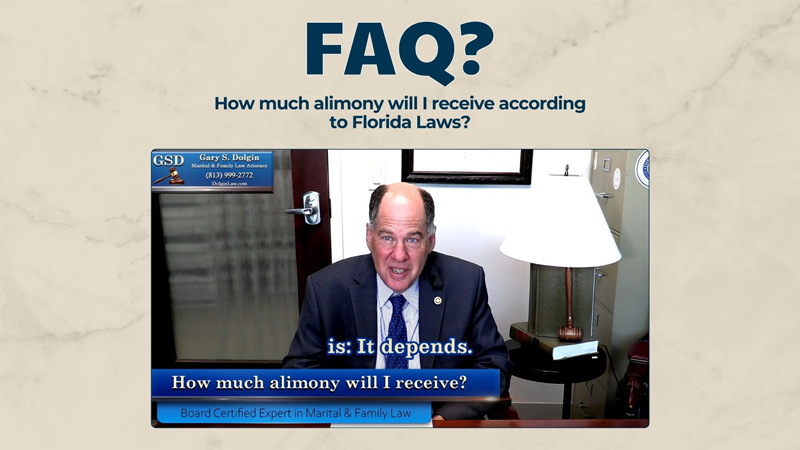
Determining Alimony in Florida FAQs
Question: How is alimony determined in Florida?
Answer: Alimony in Florida is determined under Florida Statute 61.08. Courts first evaluate whether one spouse has a financial need and whether the other spouse has the ability to pay. If both exist, the judge considers multiple factors such as the length of the marriage, standard of living, earning capacity, health, and contributions to the marriage before deciding the type, amount, and duration of alimony.
Question: Is alimony automatic in a Florida divorce?
Answer: No. Alimony is not automatic in Florida. Even in long-term marriages, a judge must still find that one spouse has a genuine financial need and that the other spouse has the ability to pay. Each alimony case is decided based on its specific facts.
Question: How long does alimony last in Florida?
Answer: The duration of alimony depends on the type of alimony awarded and the facts of the case. Bridge-the-gap alimony is short-term, rehabilitative alimony lasts until the rehabilitation plan is completed, and durational alimony lasts for a set period defined by the court. Alimony does not automatically last forever.
Question: Can alimony be modified in Florida?
Answer: Yes. Alimony may be modified if there is a substantial change in circumstances, such as a significant change in income, retirement, illness, or the receiving spouse becoming self-supporting. Modifications require court approval and proper legal proof.
Why Board Certification Matters in Alimony Cases
Alimony cases are financially complex and often highly contested. Board Certification in Marital and Family Law represents the highest level of expertise recognized by the Florida Bar.
With over 35 years of experience, Gary Dolgin brings in-depth knowledge of Florida alimony statutes, extensive experience negotiating and litigating alimony issues, and strategic advocacy tailored to each client’s financial circumstances.
At The Law Offices of Gary Dolgin, alimony cases are handled with precision, professionalism, and care because we understand how impactful alimony outcomes can be on the lives of the parties involved.
If you have questions about alimony in Tampa or Hillsborough County, it’s important to get clear legal guidance early. Alimony determinations can affect your financial stability for years to come.
The Law Offices of Gary Dolgin proudly serve clients throughout Tampa and Hillsborough County, providing detailed guidance and strong representation in alimony matters.
To schedule an alimony consultation with Gary S. Dolgin, Attorney At Law, call (813) 999-2772 and it will be our pleasure to help you.
To see what past clients have to say about retaining Gary Dolgin for alimony assistance, and to learn more about alimony, visit:
Tampa Alimony Expert – Gary S. Dolgin
Google Business Page:
Divorce Attorney Near Me – Gary Dolgin
625 E. Twiggs St., Suite 101i
Tampa, Florida 33602
Facebook Page: Tampa Divorce Attorney – Gary Dolgin