Category Archives: Child Custody

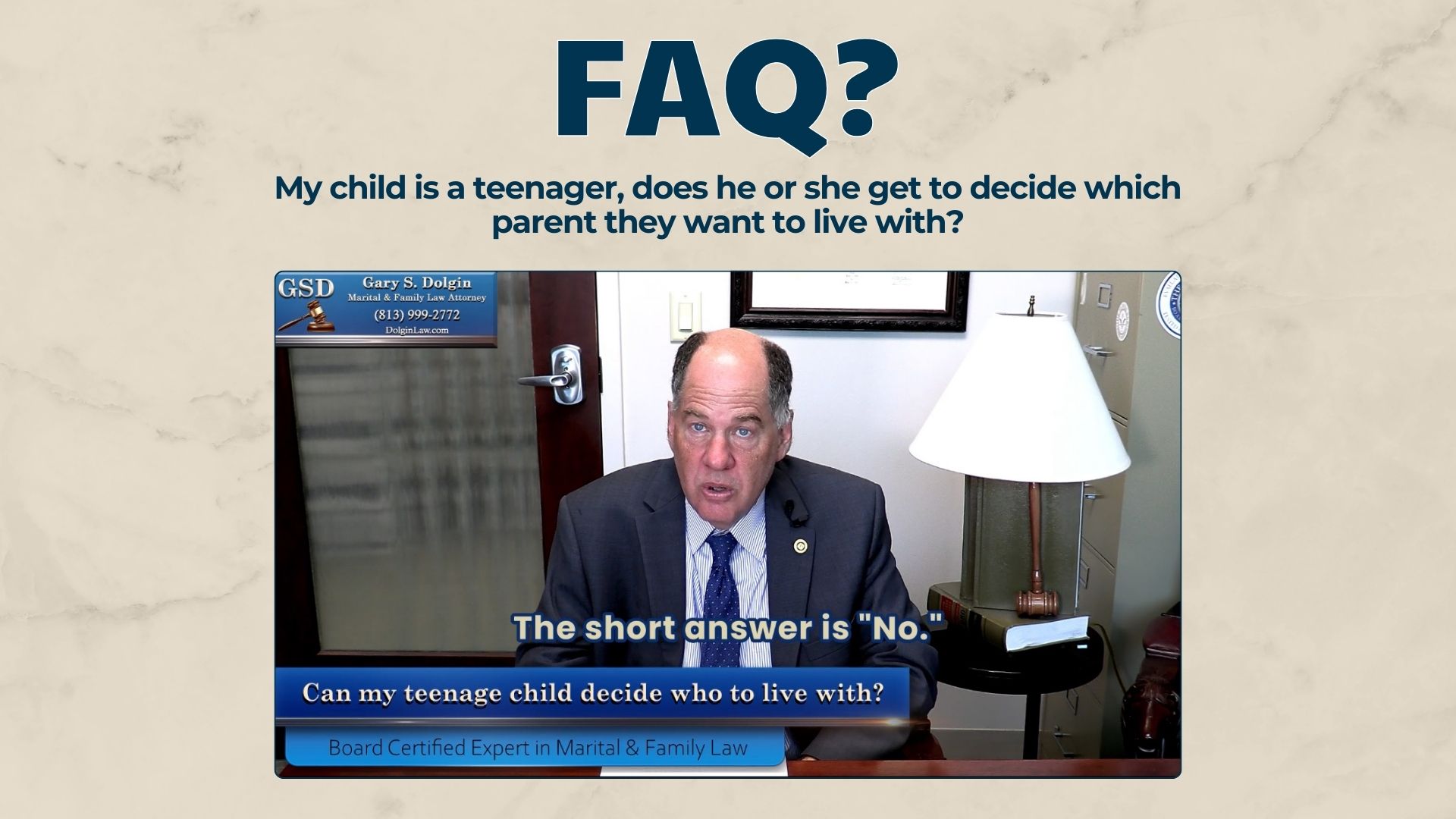
Can a Teenage Child Choose Which Parent to Live With in Florida?

When parents go through a divorce or separation, few topics create more emotional stress than deciding where a child will live. One of the most common questions family law attorneys receive, especially when the child is a teenager, is:

“Can my child decide which parent they want to live with?”

According to Gary S. Dolgin, Board Certified Expert in Marital and Family Law with over 35 years of experience, the short answer is no. However, a child’s preference can play a role in a judge’s decision, depending on their age, maturity, and specific circumstances.

Understanding how Florida courts evaluate this issue can help parents approach custody, or “time-sharing,” as Florida law calls it, with realistic expectations and confidence.

Understanding Florida’s Time-Sharing Law

In Florida, the term “child custody” has been replaced with time-sharing and parental responsibility under Florida Statute §61.13. This statute outlines how parenting plans are created, how time with the child is divided, and and whether both parents will jointly make decisions about education, health care, and other major decisions regarding the child, or if one parent will be granted ultimate decision-making authority over the child’s life.

The goal is always to serve the best interests of the child, not necessarily the preferences of the parents, or even the child alone.

The “Best Interests of the Child” Standard

When determining time-sharing and parental responsibility, Florida courts are guided by what’s known as the “best interests of the child” standard.

Florida Statute §61.13(3) lists 20 specific factors that judges must consider before making any custody or time-sharing determination. These factors include everything from the parents’ ability to meet the child’s needs, to each parent’s moral fitness, mental health, and the stability of the home environment.

Here are some of the most important factors that frequently come into play:

– The ability of each parent to encourage a close and continuing parent-child relationship.

– The anticipated division of parental responsibilities after the litigation.

– The moral fitness, mental health, and physical health of each parent.

– The home, school, and community record of the child.

– The reasonable preference of the child, if the court deems the child to be of sufficient intelligence, understanding, and experience to express a preference.

– Evidence of domestic violence, sexual violence, abuse, or neglect.

– The ability of each parent to provide a consistent routine, including discipline, meals, and homework.

– The length of time the child has lived in a stable environment and the desirability of maintaining continuity.

– The capacity of each parent to communicate with the other parent and participate in major decisions affecting the child’s welfare.

This list helps make the judge’s decision a holistic assessment of the child’s entire life situation, rather than just one or two factors.

Where a Child’s Preference Fits In

The factor regarding a child’s reasonable preference is often misunderstood.

Many parents assume that once a child reaches a certain age, such as 13, 15, or 17 they can simply “choose” where to live. Florida law does not establish any specific age at which a child can make that decision.

Instead, the judge has discretion to decide whether a child is mature enough to express a meaningful preference and how much “weight” to give that opinion.

“A child’s preference can be taken into account if they are of sufficient maturity,” explains Attorney Gary Dolgin. “However, we never want to put a child in the position of making that decision. A judge can give whatever weight they feel is appropriate to the child’s preference, taking that into account with the other 19 factors.”

Can a Teenager Decide Custody in Florida

Why Judges Avoid Letting Children Decide

While a child’s opinion matters, judges and family law professionals are cautious about giving children too much responsibility in these decisions.

As Mr. Dolgin notes, no child should ever be put in the position of choosing between parents. Doing so can create long-term emotional stress and guilt, even if the child’s preference seems clear.

Judges also understand that children can be easily influenced by short-term factors, such as which parent is more lenient, offers more freedom, or buys them more gifts. For that reason, the court looks beyond surface-level preferences and focuses on what environment will best support the child’s growth and stability.

How a Judge Evaluates a Teenager’s Preference

If a judge decides to consider the child’s wishes, the process is handled with sensitivity and discretion. Typically, the child will not testify in open court. Instead, the judge may:

1. Speak privately with the child in chambers (without the parents present) to understand their feelings, however, many judges are reluctant to interview a child and prefer to rely on the recommendation of a psychologist or guardian ad litem.

2. Rely on a guardian ad litem — a neutral advocate appointed to represent the child’s best interests.

3. Consider psychological evaluations or school counselor input to gauge maturity and emotional stability.

The judge will then weigh the child’s opinion alongside all other statutory factors before determining a parenting plan.

In some cases, a mature teenager’s consistent, well-reasoned preference may carry significant weight. In others, the court may give it little consideration if it appears the child’s choice is influenced by manipulation or temporary emotions.

Each case is unique — which is why having an experienced, Board Certified attorney is crucial to present these factors effectively.

The Role of a Board Certified Family Law Attorney

When navigating issues of custody, time-sharing, and child preference, it’s vital to have legal guidance from someone who is not only experienced but also Board Certified in Marital and Family Law.

Gary S. Dolgin is one of only 274 attorneys in the entire State of Florida with this distinction. Board Certification is the highest level of recognition given by The Florida Bar, reserved for attorneys who have demonstrated exceptional competence, ethics, and professionalism in their field.

With over three decades of experience in family law, Mr. Dolgin has helped countless families in the Tampa Bay area navigate complex time-sharing and custody matters with compassion and expertise.

The Importance of Proper Legal Guidance

Because time-sharing decisions are highly fact-specific, it’s risky for parents to rely on hearsay, internet information, or assumptions about what a judge “usually does.”

An attorney like Gary Dolgin can:

– Help you understand how the 20 statutory factors apply to your unique case.

– Prepare evidence showing your ability to meet your child’s best interests.

– Ensure that your child’s voice is heard appropriately — without causing emotional harm.

– Negotiate fair parenting plans that reduce conflict and protect your child’s emotional well-being.

The goal is always to create a stable, loving environment where the child can thrive, while respecting both parents’ roles in the child’s life.

Protecting Children from Conflict

Family law judges, guardians, and attorneys all share one guiding principle: children should be shielded from adult conflict.

Encouraging a child to “choose sides” can create deep emotional scars and complicate the healing process after divorce. Instead, parents are encouraged to:

– Keep conversations about custody between adults.

– Reassure children that both parents love them.

– Avoid making negative comments about the other parent in the child’s presence.

– Focus on consistency, love, and communication.

As Mr. Dolgin emphasizes, “We never want to put a child in the position of making that decision.”

A judge’s role — and your attorney’s — is to ensure the child’s well-being remains the top priority.

What Happens If Parents Can’t Agree on Time-Sharing

If parents cannot agree on a parenting plan, the court will create one based on the evidence presented. The judge may order mediation, psychological evaluations, or the appointment of a guardian ad litem to assess family dynamics.

The court will then issue a Parenting Plan, which defines:

1. The time each parent spends with the child (time-sharing schedule).

2. Decision-making authority for major issues like education, health, and extracurriculars.

3. Communication expectations between parents.

This Parenting Plan becomes legally binding — and modifying it later requires showing a substantial change in circumstances and that the change is in the child’s best interests.

Frequently Asked Questions

Question: Can a teenager choose which parent to live with in Florida?
Answer: No. A teen’s preference may be considered by the court but it is only one of the best-interest factors under Florida Statute 61.13. The judge decides based on all relevant factors, including the child’s maturity and each parent’s ability to meet the child’s needs.

Question: At what age will a Florida court consider a child’s preference?
Answer: There is no specific age. Courts look at whether the child is sufficiently mature to express a well-reasoned preference. Older teens often receive more weight, but maturity—not age alone—controls.

Question: How does a judge hear a child’s preference?
Answer: Judges may rely on testimony from parenting evaluators or, in some cases, speak with the child in camera (privately in chambers) to avoid placing the child in the middle of the dispute.

Question: What other factors affect time-sharing decisions?
Answer: Courts consider many factors, including each parent’s involvement, stability, moral fitness, mental and physical health, co-parenting, the child’s school and community history, and any evidence of domestic violence, among others listed in Florida Statute 61.13.

Question: Should I ask my child to choose a parent?
Answer: Generally no. Courts discourage placing children in the position of choosing. Instead, work with an experienced family-law attorney to present the child’s needs appropriately and build a parenting plan that supports the child’s best interests.

When to Seek Legal Help

If you’re facing a custody or time-sharing dispute in Tampa, it’s important to seek legal advice early. Even if you and your co-parent have an amicable relationship, the process involves strict statutory requirements and detailed documentation.

A consultation with an experienced attorney like Gary S. Dolgin can help you understand your rights under Florida law, avoid common mistakes that could hurt your case, and help you develop a strategy that prioritizes your child’s needs while protecting your parental rights.

About The Law Offices of Gary S. Dolgin

Located in Tampa, Florida, The Law Offices of Gary S. Dolgin focuses exclusively on Marital and Family Law, including:

– Divorce and equitable distribution

– Child custody and time-sharing disputes

– Alimony and support modifications

– Paternity and parental responsibility matters

With a reputation built on trust, integrity, and compassion, Gary Dolgin and his team treat every client like family — guiding them through some of life’s most difficult transitions with professionalism and care.

If you have questions about time-sharing, parental responsibility, or child custody laws in Florida, we’re here to help.

To schedule a consultation with Gary S. Dolgin, Attorney At Law, call (813) 999-2772 and it will be our pleasure to help you.

Paternity Rights Tampa – The law as it pertains to a couple who have a child out of wedlock.

When a child is born out of wedlock, the legal dynamics of parental rights and responsibilities can be complex. However, the law provides clear guidelines to ensure that both parents have a defined role in the child’s life. (See Florida Statutes)

This is crucial for the child’s overall development and well-being, as it ensures that both parents are involved in their upbringing.

In cases where paternity has been established under Florida Statutes s. 742.011 or s. 742.10, both the mother and the father of the child are recognized as the natural guardians. This designation as natural guardians means that both parents are legally acknowledged as having equal rights and responsibilities concerning the upbringing, care, and welfare of the child.

All decisions and arrangements made under the natural guardianship are ultimately guided by what is in the best interest of the child. Courts and legal frameworks prioritize the child’s welfare, ensuring that both parents fulfill their roles effectively. This approach helps to create a stable and supportive environment for the child, promoting their physical, emotional, and psychological development while ensuring that they receive the care and attention they need from both parents.

Here at The Law Offices of Gary S. Dolgin, we have been helping mothers and fathers with child custody issues such as parenting plans for over 33 years in the Tampa area.

We have also been committed to protecting children’s best interests while helping to advocate for their parent’s rights.

If you have any questions about parenting plans or any other child custody issues, give us a call at (813) 999-2772, and it will be our pleasure to help you.

Learn more about child custody and paternity rights Tampa, by visiting:
Best Child Custody Lawyer in Tampa

The court shall determine all matters relating to parenting and time-sharing of each minor child of the parties in accordance with the best interests of the child and in accordance with the Uniform Child Custody Jurisdiction and Enforcement Act, except that modification of a parenting plan and time-sharing schedule requires a showing of a substantial and material change of circumstances.

The primary focus is always on the child’s well-being and needs. Factors considered include the child’s:

– age;
– health;
– emotional ties with each parent;
– the child’s home
– the child’s school;
– and their community record.

In order to modify a parenting plan and time-sharing schedule the party requesting the modification must show a substantial and material change of circumstances, such as a job relocation, a change in health, or a change in the child’s educational needs.

In determining time-sharing, a judge must consider 20 factors regarding the best interests of the child. Some of these factors include:

(a) The demonstrated capacity and disposition of each parent to facilitate and encourage a close and continuing parent-child relationship, to honor the time-sharing schedule, and to be reasonable when changes are required.
(b) The anticipated division of parental responsibilities after the litigation, including the extent to which parental responsibilities will be delegated to third parties.
(c) The demonstrated capacity and disposition of each parent to determine, consider, and act upon the needs of the child as opposed to the needs or desires of the parent.
(d) The length of time the child has lived in a stable, satisfactory environment and the desirability of maintaining continuity.

Here at The Law Offices of Gary S. Dolgin, we have been helping mothers and fathers with child custody issues such as parenting plans for over 33 years in the Tampa area.

We have also been committed to protecting children’s best interests while helping to advocate for their parent’s rights.

If you have any questions about parenting plans or any other child custody issues, give us a call at (813) 999-2772, and it will be our pleasure to help you.

Learn more about child custody by visiting:
Best Tampa Child Custody Lawyers, Gary Dolgin

“Parenting plan” means a document created to govern the relationship between the parents relating to decisions that must be made regarding the minor child and must contain a time-sharing schedule for the parents and child.

A parenting plan approved by the court must, at a minimum:

1. Describe in adequate detail how the parents will share and be responsible for the daily tasks associated with the upbringing of the child;

2. Include the time-sharing schedule arrangements that specify the time that the minor child will spend with each parent;

3. Designate who will be responsible for:

a. Any and all forms of health care. If the court orders shared parental responsibility over health care decisions, either parent may consent to mental health treatment for the child unless stated otherwise in the parenting plan.

b. School-related matters, including the address to be used for school-boundary determination and registration.

c. Other activities; and

4. Describe in adequate detail the methods and technologies that the parents will use to communicate with the child.

Here at The Law Offices of Gary S. Dolgin, we have been helping mothers and fathers with child custody issues such as parenting plans for over 33 years in the Tampa area.

We have also been committed to protecting children’s best interests while helping to advocate for their parent’s rights.

If you have any questions about parenting plans or any other child custody issues, give us a call at (813) 999-2772, and it will be our pleasure to help you.

Learn more about child custody by visiting:
Tampa Child Custody Lawyers, Gary Dolgin

A parent coordinator in divorce serves as a neutral third-party professional who helps separated or divorced parents navigate co-parenting challenges more effectively.

A parenting coordinator must immediately inform the court by affidavit or verified report without notice to the parties of an emergency situation if:

1. There is a reasonable cause to suspect that a child will suffer or is suffering abuse, neglect, or abandonment;

2. There is a reasonable cause to suspect a vulnerable adult has been or is being abused, neglected, or exploited;

3. A party, or someone acting on a party’s behalf, is expected to wrongfully remove or is wrongfully removing the child from the jurisdiction of the court without prior court approval or compliance with the requirements of s. 61.13001. If the parenting coordinator suspects that the parent has relocated within the state to avoid domestic violence, the coordinator may not disclose the location of the parent and child unless required by court order.

Here at The Law Offices of Gary S. Dolgin, we have been helping mothers and fathers with child custody issues such as parent coordination for over 33 years in the Tampa area.

We have also been committed to protecting children’s best interests while helping to advocate for their parent’s rights.

If you have any questions about parent coordination or any other child custody issues, give us a call at (813) 999-2772, and it will be our pleasure to help you.

Learn more about child custody by visiting:
Custody Lawyer Tampa FL, Gary Dolgin

A parent coordinator in divorce serves as a neutral third-party professional who helps separated or divorced parents navigate co-parenting challenges more effectively.

The court shall determine the allocation of fees and costs for parenting coordination between the parties.

The court may not order the parties to parenting coordination without their consent unless it determines that the parties have the financial ability to pay the parenting coordination fees and costs.

(a) In determining if a nonindigent party has the financial ability to pay the parenting coordination fees and costs, the court shall consider the party’s financial circumstances, including income, assets, liabilities, financial obligations, resources, and whether paying the fees and costs would create a substantial hardship.

(b) If a party is found to be indigent based upon the factors in s. 57.082, the court may not order the party to parenting coordination unless public funds are available to pay the indigent party’s allocated portion of the fees and costs or the nonindigent party consents to paying all of the fees and costs.

Here at The Law Offices of Gary S. Dolgin, we have been helping mothers and fathers with child custody issues such as parent coordination for over 33 years in the Tampa area.

We have also been committed to protecting children’s best interests while helping to advocate for their parent’s rights.

If you have any questions about parent coordination or any other child custody issues, give us a call at (813) 999-2772, and it will be our pleasure to help you.

Learn more about child custody by visiting:
Tampa Custody Attorney, Gary Dolgin

If there has been a history of domestic violence, the court may not refer the parties to parenting coordination unless both parents consent.

The court shall offer each party an opportunity to consult with an attorney or domestic violence advocate before accepting the party’s consent.

The court must determine whether each party’s consent has been given freely and voluntarily.

In cases involving a history of domestic violence, it’s crucial for the court to prioritize safety and well-being.

Therefore, the court ensures that both parties have the opportunity to seek guidance from an attorney or domestic violence advocate before proceeding with parenting coordination.

Here at The Law Offices of Gary S. Dolgin, we have been helping mothers and fathers with child custody issues for over 33 years in the Tampa area.

We have also been committed to protecting children’s best interests while helping to advocate for their parent’s rights.

To schedule a child custody consultation with Gary Dolgin, give us a call at (813) 999-2772, and it will be our pleasure to help you.

Learn more about child custody by visiting:
Domestic Violence Attorney Tampa, Gary Dolgin

The Vital Role of Parent Coordinators in Divorce: Navigating Co-Parenting Challenges with Expert Guidance

Divorce is a complex and emotionally challenging process, especially when children are involved.

Co-parenting after divorce requires effective communication, cooperation, and a focus on the children’s well-being. However, navigating all this can be overwhelming for many families, especially if the parties are not on good terms.

This is where parent coordinators step in to assist with child custody matters. Serving as neutral third-party professionals, parent coordinators play an important role in helping divorced or separated parents navigate co-parenting challenges more effectively.

Let’s discuss the role of parent coordinators, explore their key responsibilities and the impact they have on promoting healthy co-parenting relationships.

The Role of Parent Coordinators:

Parent coordinators are trained professionals with expertise in family dynamics, conflict resolution, and child development.

Their primary role is to facilitate communication, reduce conflicts, and promote healthy decision-making regarding the children’s well-being.

The following are some key responsibilities of parent coordinators:

Facilitating The Resolution of Disagreements

One of the central roles of parent coordinators is to facilitate the resolution of disagreements between divorced or separated parents. They help parents reach agreements on various parenting and child custody matters by facilitating discussions and finding common ground.

Some court orders authorize the parenting coordinator to decide a dispute on a temporary basis until the parties can obtain a court hearing where the judge can resolve the dispute.

Whether it’s deciding on parenting schedules, educational decisions, or extracurricular activities, parent coordinators provide a safe and effective environment for these types of discussions.

Implementing Parenting Plans

Parent coordinators ensure that the parenting plan established during the divorce process is followed and enforced. This involves overseeing the implementation of custody arrangements, visitation schedules, and other provisions outlined in the parenting plan. By ensuring compliance with court orders, parent coordinators help maintain consistency and stability for the children.

Providing Education and Guidance

Effective co-parenting requires a set of skills that not all parents possess. Parent coordinators offer guidance on effective communication strategies, conflict resolution techniques, and parenting skills to improve the co-parenting relationship. Through education and coaching, they empower parents to better handle the challenges and make informed decisions in the best interests of their children.

Making Recommendations

In situations where parents cannot agree, the parent coordinator may make recommendations to resolve disputes. These recommendations are based on their expertise and understanding of the family’s dynamics. Although they are not legally binding, these recommendations can serve as a helpful guide for parents who are trying to resolve conflicts amicably. In some cases, recommendations may be incorporated into the parenting plan or presented to the court for approval.

Monitoring Compliance

Parent coordinators play a crucial role in monitoring compliance with court orders and the parenting plan. They keep track of parenting time, communication between parents, and any deviations from the agreed-upon arrangements. If there are violations or breaches, parent coordinators intervene promptly to address the issue and prevent further escalation.

Impact of Parent Coordinators on Co-Parenting Relationships

Overall, the goal of parent coordinators is to minimize conflict, prioritize the children’s best interests, and promote a cooperative co-parenting relationship between divorced or separated parents.

By facilitating communication and providing support, parent coordinators help families navigate the challenges of divorce more smoothly.

Studies have shown that families who work with parent coordinators experience lower levels of conflict and higher levels of satisfaction with their co-parenting arrangements.

In addition, children benefit from the stability and consistency that parent coordinators help establish, leading to better outcomes in terms of emotional well-being and adjustment to the new family dynamic.

By fostering a cooperative co-parenting relationship, parent coordinators contribute to the long-term success and happiness of families transitioning through divorce.

If you’re facing a divorce with difficult child custody issues, it is important to seek the guidance of the best Tampa child custody lawyers who can help be an advocate for the best interests of your children.

A parent coordinator in divorce serves as a neutral third-party professional who helps separated or divorced parents navigate co-parenting challenges more effectively.

They are appointed by the court or agreed to by the parties. Their main role is to assist the parties in successfully creating or implementing a parenting plan.

They also assist in facilitating communication, reducing conflicts, and promoting healthy decision-making regarding the children’s well-being.

Parent coordinators more specifically assist in resolving disputes related to parenting schedules, educational decisions, extracurricular activities, and other co-parenting issues.

Key responsibilities of a parent coordinator may include:

– Mediating disagreements

– Implementing parenting plans

– Providing education and guidance

– Making recommendations

– Monitoring compliance

Overall, the goal of a parent coordinator is to minimize conflict, prioritize the children’s best interests, and promote a cooperative co-parenting relationship between divorced or separated parents. By facilitating communication and providing support, parent coordinators help families navigate the challenges of divorce more smoothly and promote the well-being of the children involved.

Here at The Law Offices of Gary S. Dolgin, we have been helping mothers and fathers with child custody issues for over 33 years in the Tampa area.

We have also been committed to protecting children’s best interests while helping to advocate for their parent’s rights.

To schedule a child custody consultation with Gary Dolgin, give us a call at (813) 999-2772, and it will be our pleasure to help you.

Learn more about child custody by visiting:
Custody Attorney Tampa, Gary Dolgin

Shared parental responsibility is typically ordered by judges, and requires both parents to consult with each other regarding all major decisions regarding their children. For example, medical decisions, educational decisions, etc.

However, in some cases, sole parental responsibility can be ordered if shared parental responsibility would be detrimental to a child.

One example of shared parental responsibility being detrimental to a child would be if there is domestic violence. For instance, if there is a parent or a child who believes that they are in imminent danger of becoming a victim of domestic violence, or have been a victim of domestic violence in the past.

If you have questions regarding parental responsibility, domestic violence, or any other child custody issue, give us a call.

We will be happy to answer all of your questions.

Here at The Law Offices of Gary S. Dolgin, we have been helping mothers and fathers with child custody for over 33 years in the Tampa area.

We have also been committed to protecting children’s best interests while helping to advocate for their parent’s rights.

To schedule a child custody consultation with Gary Dolgin, give us a call at (813) 999-2772, and it will be our pleasure to help you.

Learn more about child custody by visiting:
Best Custody Lawyer Tampa, Gary Dolgin

1 2 3 7